Seamless vs Sectional Gutters in Columbia: Which Is Right for Your Home?
Choosing by habit or by price tag alone, then discovering the other system's costs one repair at a time.
Read the Guide
Assuming the coast's checklist applies inland, or assuming distance from the coast means no preparation at all.
Problem: Assuming the coast's checklist applies inland, or assuming distance from the coast means no preparation at all.
Solution: Prepare for what the Midlands actually get: days of heavy rain from tropical remnants - empty gutters, proven downspouts, discharge moved away from the foundation before the system arrives.
When to call: Ask a professional when post-storm inspection finds sagging runs, spilled elbows or new foundation ponding - those are repairs, not cleanup.
Columbia does not get hurricanes; Columbia gets what hurricanes leave behind - and the October 2015 flood taught this city what two days of tropical rain can do to its creeks, its canal and its houses. The remnants of Hugo, Matthew and Florence all delivered the same test: not wind, but volume - rain measured in inches per day arriving on ground already wet. A gutter system either passes that water deliberately or it fails at the foundation. This checklist is the inland version, built for that test.
Then there are the storms with names and dates. Hurricane Hugo's remnants crossed the Midlands in 1989; Matthew and Florence brushed the region with days of rain; and in October 2015, Columbia lived through a flood event that breached the canal, drowned neighborhoods along Gills Creek and rewrote how this city thinks about drainage. Gutters are a small part of that story, but they are the part attached to your house: where they put a roof's worth of water during the worst hour of the year is a decision someone makes, on purpose or by neglect.
The failure mode is endurance, not impact. A thunderstorm tests a gutter for an hour; a remnant tests it for two days. Every small dam - the outlet half-bridged with needles, the elbow carrying spring's paste - performs for forty-eight hours straight, and overflow that would be a nuisance in a storm becomes a soaking: fascia saturated, beds excavated, crawlspaces fed from above.
The second mode is volume at the ground. Downspouts that discharge acceptably in ordinary rain deliver a small river across two days, and clay that was merely damp on day one is saturated and ponding by day two. Discharge that ends at the wall is a fair-weather arrangement; tropical rain exposes it at exactly the moment moving it is impossible.
The Atlantic season opens June 1 and the Midlands' risk concentrates from August into October, which makes early summer the preparation window. The list is short and specific: a full cleaning with outlets and elbows opened, a flow test on every downspout, joint sealant checked while it can still cure in dry weather, and hangers verified along any run that sagged the spring before.
Discharge gets its own appointment. Extensions should be in place and tight, buried lines flushed through their cleanouts, emitters clear of mulch, and any downspout still ending at the wall given its extension or line now - in June, on a dry weekend, not in September with a system approaching.
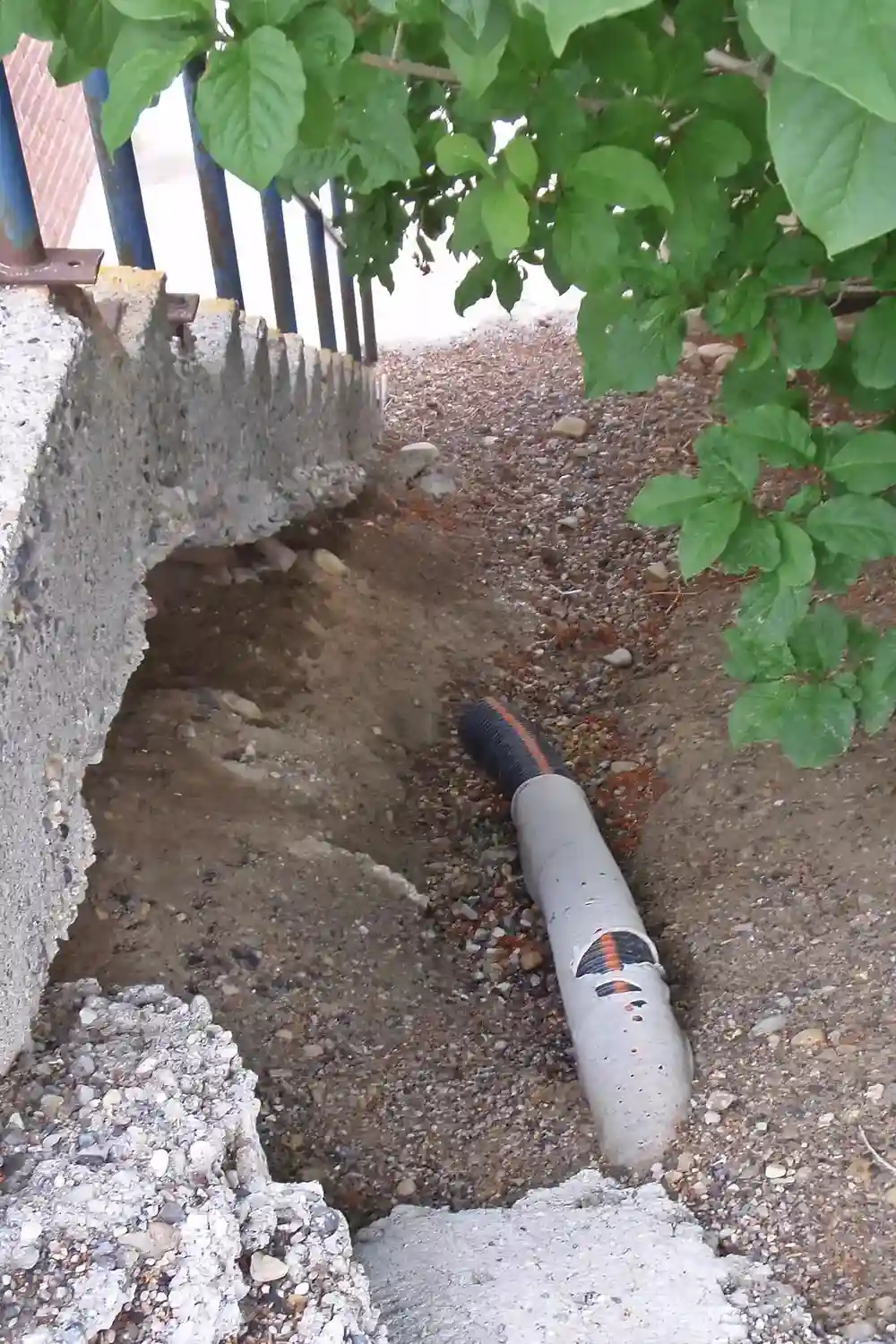

Little on a ladder belongs in that week; the work is at ground level. Clear the surface debris from guards and strainers, confirm extensions are connected and pointed at falling ground, move anything stored against the foundation's discharge corners, and photograph the system and the yard. Those photographs are the baseline every post-storm comparison and insurance conversation will want.
Check the known weak points from the ground with binoculars if you have them: the corner that drips, the run that ponds, the elbow that spilled last season. Knowing where the system will fail lets you watch the right places during the rain - and overflow observed live is diagnosis no later inspection can match.
Walk the system when the ground firms, looking for the storm's specific signatures: runs shifted or newly sagging under debris weight, elbows spilled at their joints, discharge points excavated or buried by washed soil, and new ponding lines at the foundation. Tropical debris loads are the heaviest of the year - a post-storm cleaning is a standard Midlands appointment, not an overreaction.
Then read the ground. The October 2015 lesson for Columbia homeowners was that drainage is a whole-lot system: gutters, discharge, grading and the creek at the bottom of the street are one chain. A storm that rearranges any link - a swale silted, a line crushed by a fallen limb - changes what the next storm will do, and the time to learn that is the calm week after, not the wet day of.
The city's reference events span three decades of the same lesson. Hugo's remnants in 1989 proved an inland city could take a hurricane's rain without its wind. Matthew in 2016 and Florence in 2018 delivered multi-day soaking to ground already wet. And October 2015 - the thousand-year rain event that breached the Columbia Canal and flooded the Gills Creek watershed - stands as the region's proof that water volume, arriving steadily, is the Midlands' true storm hazard.
Each event damaged houses through the same unglamorous pathway: drainage that was adequate for ordinary rain, overwhelmed by duration. Gutters are one link of that drainage, and the link a homeowner fully controls. The historical argument for the June checklist is simply that every one of those events found the same small failures - dammed outlets, wall-side discharge - and billed them at storm prices.
The limb over the roof is a gutter problem scheduled by weather. Tropical remnants arrive with enough wind to take the dead and the weak, and a limb through a gutter run converts the system's whole section into a spillway at the worst hour. A pre-season tree pass - dead limbs out, hangers-over-roof trimmed back - is storm preparation as much as any cleaning.
The debris argument runs parallel: a canopy already thinned by judicious trimming delivers a smaller storm load into the runs. Neither intervention is about tidiness. They are about the two ways trees attack gutters in a storm - by impact and by volume - both of which are best answered in June.
Insurers read maintenance. A documented gutter and drainage history - cleaning invoices, dated photographs, condition reports - supports a homeowner's position after storm damage in ways memory cannot. The pre-storm photograph habit in this guide's checklist is not bureaucracy; it is the baseline that separates 'the storm did this' from 'this was already failing'.
The same records serve the repair conversation. Post-storm, every contractor in the Midlands is booked and triaging; the homeowner who can show a system that was sound in June gets scheduled as storm repair, while undocumented failures join a longer queue of deferred maintenance. Preparation buys priority as well as protection.
The general gutter visit is the system's physical exam, and its value is the order it brings to a dozen small observations: the run that ponds slightly at its far end, the corner whose sealant has gone chalky, the elbow carrying a season of needles, the downspout whose shoe dumps at the wall. None of them is the story alone; together they are the story, and a general visit is the appointment that reads them as one.
That is the service side of this guide's subject. When you are ready, the Gutter Services page carries the process, the coverage by neighborhood and the number to call.
Runs cleared, every outlet and elbow opened, every downspout proven with water - the system's tropical baseline.
Each downspout's ending checked: extension tight, line flushed, emitter clear, ground falling away.
Joints addressed while curing is possible; a wet-week reseal is a placebo.
Roofline, discharge points and yard - the baseline for every after-action.
Storm signatures read, debris load removed, discharge damage repaired before the next system forms.
Early-summer cleaning done, outlets and elbows opened, every downspout flow-tested
extensions tight, buried lines flushed, emitters clear, no drop ending at the wall
Overhanging dead limbs removed and canopy over the roof thinned back
System and yard photographed as the pre-season baseline
A pre-season professional visit scoped for storm readiness covers the full cleaning standard plus the storm-specific items: hanger integrity along every run, joint sealant condition while dry-weather curing is possible, downspout strapping, and the discharge audit at ground level. It is the regular visit with its eyes open to the season.
Post-storm, the corresponding scope is inspection before cleaning: shifted runs, spilled elbows and crushed sections identified and photographed before debris is removed, so storm damage is documented as storm damage. The order - document, then clear, then repair - protects both the house and any claim that follows.
Storm preparation is the one gutter service whose value is proven by an absence - the damage that does not happen in October. Professionals in the Midlands learn to sell it in June with documentation rather than drama: last year's condition report, the discharge photograph, the specific outlet that dammed in spring. Evidence persuades where forecasts cannot.
Waiting for a named storm to start preparation, when every crew in the region is already booked
Resealing joints in the wet week before a system arrives and counting it as preparation
Cleaning after a storm before photographing impact damage - the documentation is part of the repair
Columbia cannot schedule its storms, but it can meet them with empty gutters, proven downspouts and discharge that ends on falling ground. June's checklist is short, and every item on it is one the October version of you will be grateful for.
Choosing by habit or by price tag alone, then discovering the other system's costs one repair at a time.
Read the GuideTreating eave rot as a paint problem while the gutter above keeps delivering the water that causes it.
Read the GuideThe Atlantic season runs June 1 to November 30, and the Midlands' remnant risk concentrates from August through October - Matthew arrived in October, Florence in September, and the 2015 flood in early October. The preparation window that matters is early summer.
No - inland, the gutter is part of the defense, not the vulnerability. Wind-rated removal advice belongs to coastal storm-surge country. In Columbia the correct preparation is the opposite: gutters clean, tight, and proven, ready to move two days of rain away from the house.
Sags and shifts from debris weight, spilled or separated elbows, runs dented by limbs, discharge points excavated or silted shut, and any new ponding at the foundation. Photograph findings before cleanup if insurance may be involved.
Gutters govern roof water only - they cannot hold back a creek. What they do in extreme rain is keep the roof's share from adding to the foundation's burden at the worst hour, and deliver it to discharge points chosen for exactly that event. In a flood-scale storm, that margin is the system's whole job.
One call connects you with a gutter professional serving Columbia and the surrounding Midlands communities - installation, repair, cleaning, guards and drainage.
📞 Call Now